Rejuvenation of the Lips and Midface
Machine translation
Original article is written in RU language (link to read it) .
Introduction
Many women during the pre- and postmenopausal periods experience a loss of skin elasticity and gravitational ptosis, as hormonal changes lead to atrophy of the musculoaponeurotic system (SMAS) and resorption of the facial bones.
Product Selection
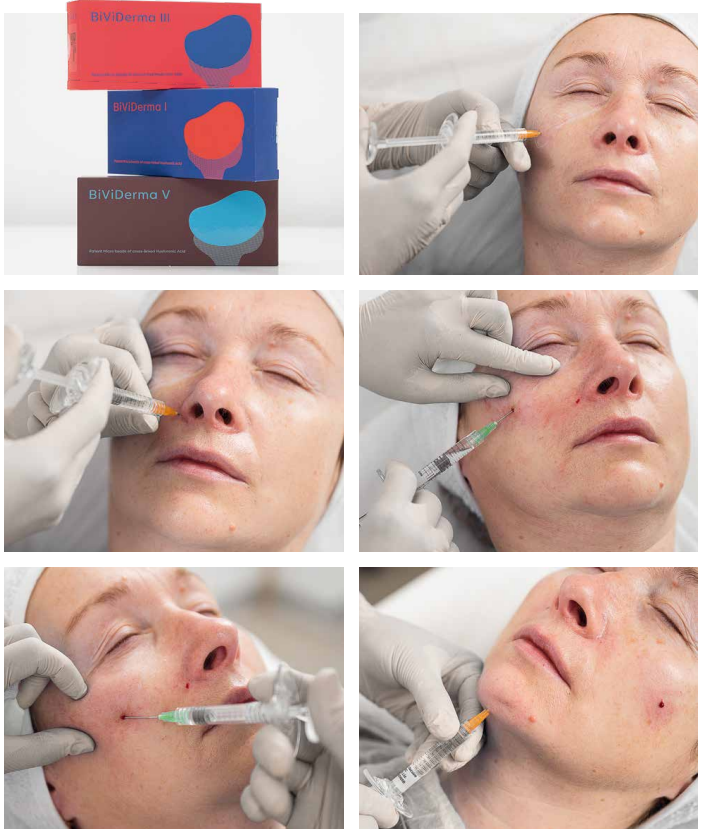
BiViDerma V and III products with lidocaine at a concentration of 3 mg/ml, manufactured by BioPlus Co., Ltd. in South Korea, are well suited for volumetric correction procedures.
These fillers are manufactured using a special technology that involves the use of the DVS cross-linking agent (divinyl sulfone). This allows the fillers to integrate optimally into the tissues, ensuring a pain-free experience both during the procedure and throughout the recovery period.
Clinical Case
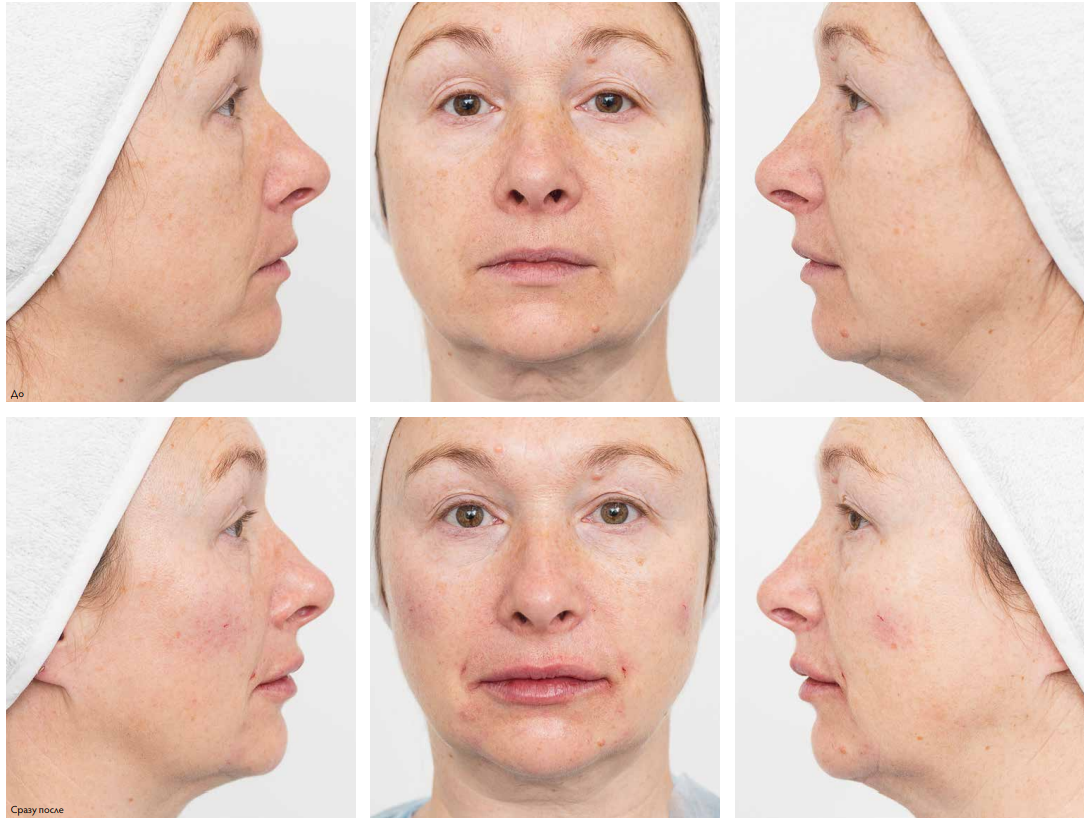
The patient is a 51-year-old woman in the premenopausal period. She complains of deep nasolabial folds, under-eye bags, pronounced nasojugal grooves, and dry, dehydrated lips. Visual examination reveals a lack of soft tissue in the midface and chin. In addition, perioral rhytides have formed.
Procedure Protocol
Step 1. Product — BiViDerma V with lidocaine 0.3 mg/ml, 3 ml
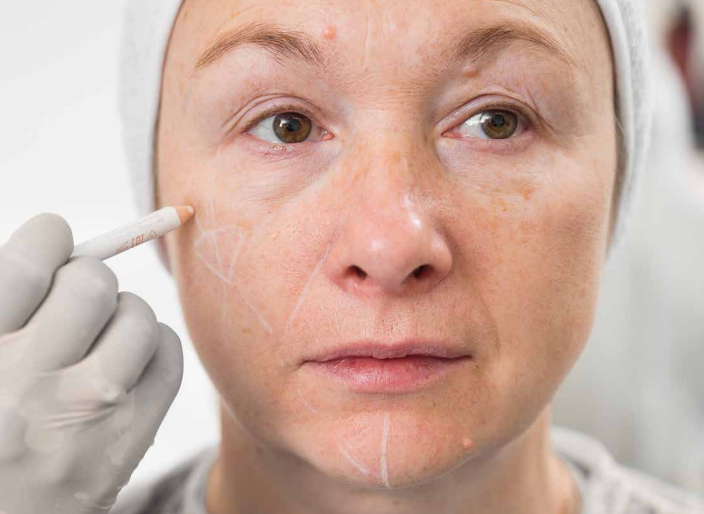
Midface correction is performed using a 25G×13 mm needle. It is inserted into the area of McGregor's point until it contacts the periosteum. A 0.4 ml bolus of the product is injected at each injection site on both sides.
Next, a 25G×13 mm needle is inserted into the pyriform space perpendicular to the bone, again until it contacts the periosteum. Boluses of 0.15 ml of the product are also injected on both sides.
The third injection is performed using a 21G×50 mm cannula. For accurate placement, a trocar is inserted at the intersection of the masseteric and zygomatic ligaments. The cannula is advanced to the periosteum along the projection of the zygomatic ligament, reaching the midpupillary line. On withdrawal, the mid-cheek groove is filled using a linear retrograde technique, with 0.4 ml of the product on each side.
The mental area is corrected using a 25G×13 mm needle. The injection point is located on the midline between the two mental eminences. The needle is inserted perpendicular to the skin surface until it contacts the periosteum, where 0.5 ml of the product is injected as a bolus.
The remaining 0.5 ml is injected into the nasolabial folds using a cannula, 0.25 ml on each side, with a linear retrograde technique. The entry point is made with a trocar in the lower third of the nasolabial fold, 0.5 cm above the corner of the mouth.
Step 2. Product — BiViDerma III with lidocaine 0.3 mg/ml, 1 ml
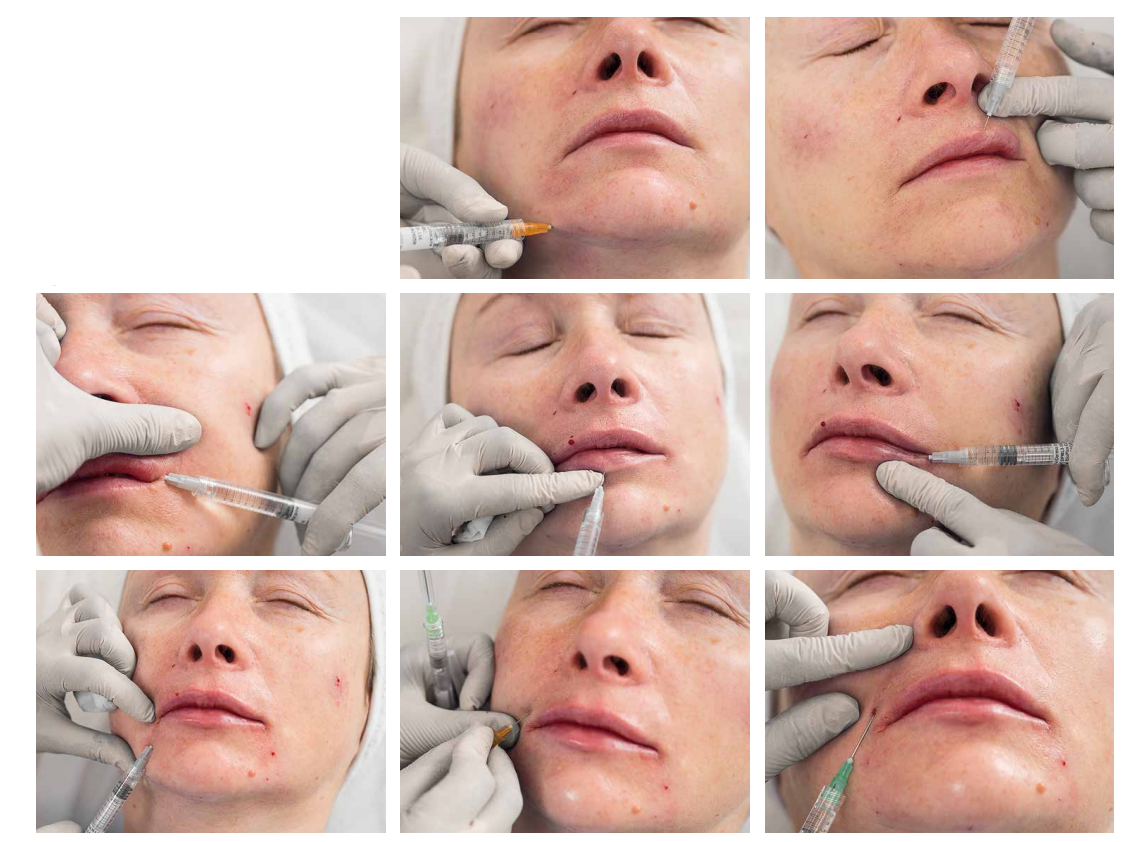
To enhance lip definition, we correct only the lateral areas of the upper lip at the vermilion border, using the Paris technique. The 27G×13 mm needle is turned slightly outward, and 0.35 ml of the product is distributed as evenly as possible.
To accentuate volume in the center of the lower lip, we use a linear retrograde fanning technique, distributing the gel in the central subvermilion area.
Using the remaining product, 0.35 ml on each side, we fill the lateral part of the vermilion, as well as the area beneath the oral commissures and the marionette lines, using a linear retrograde technique in the mid-dermis to lift the corners of the mouth.
Makeup may be applied one hour after the procedure. For the first three days, the use of aggressive skincare products is not recommended, including abrasive scrubs and alcohol-based lotions. For two weeks, avoid intense sun exposure and do not visit bathhouses, saunas, or tanning salons. Sleep in a comfortable position without putting pressure on the treated area. After lip correction, avoid hot, spicy, and hard foods for three days.
There is no rehabilitation period, or it is minimal. Post-traumatic swelling and mild bruising may occur during the first 24 hours after the procedure.
Correction Results
A maximal lifting effect was achieved, and pronounced facial ptosis was corrected by restoring lost fat volume.