

Comprehensive Correction of a Complex Morphotype: Choosing a Product for Facial Contouring in Older Patients with the Edematous-Deformational Aging Type
Machine translation
Original article is written in RU language (link to read it) .
Introduction
Modern aesthetic medicine is increasingly encountering a phenomenon known as “filler fatigue.” There is a growing trend toward avoiding injections with hyaluronic acid-based fillers to prevent swelling and puffiness after the procedure. All this requires the practitioner to carefully select a product for safe correction, especially for older patients with an edematous-deformational aging morphotype.
Why does filler fatigue occur? There are several reasons: repeated injection of HA filler into the same anatomical areas, with a cumulative effect; a short interval between contouring procedures; and a mismatch between the rheological properties of the filler and the biomechanical characteristics of the tissues.
Product selection
The BiViDerma product range from Bioplus Co., Ltd. is manufactured using the cross-linking agent DVS (divinyl sulfone) for stabilized HA.
Without a cross-linking agent, a product such as a filler cannot exist. Chemical modification is therefore required to increase the time it remains in the tissue. The purpose of cross-linking is not only to improve biomechanical properties but also to ensure a high level of biocompatibility and biological activity.
Concerns about the toxicity of DVS alone are unfounded; all cross-linking agents are toxic. Hyaluronic acid-based fillers cross-linked with BDDE (1,4-butanediol diglycidyl ether) also have side effects. The DVS molecule is smaller than BDDE and has a more compact structure. The molecular weight of BDDE is 202.25 Da, while that of DVS is 118.15 Da. The DVS molecule is one-third the length of BDDE. The atomic t-bonds in BDDE cross-linking form 14 valence bridges between HA molecules, whereas in DVS cross-linking there are only five. As a result, the distance between cross-linked HA molecules is reduced, providing denser cross-linking of HA molecules and forming a more compact cross-linked product. This affects the cohesive properties of the filler: it retains its integrity for longer under deforming forces after injection into the dermis.
Thus, the DVS molecule is half the size of the BDDE molecule and provides denser cross-linking of HA molecules at a substantially lower HA concentration in the finished product (20 mg/ml in all products). Although DVS is a more toxic cross-linking agent, considerably less is required to manufacture the filler than BDDE; the cross-linking is denser, and the free DVS content is minimal—1 ppm in the finished gel (with a permissible level of no more than 2 ppm). In addition, the safety of BiViDerma fillers is achieved through extensive washing after the divinyl sulfone cross-linking process.
One factor affecting the rheological properties of a filler and determining its hydrophilicity is the HA concentration in the product: the higher the concentration (above 20 mg/ml), the greater the likelihood of edema.
There are six BiViDerma products on the market to address a range of aesthetic needs (three products of varying density with lidocaine and three products of varying density without lidocaine). BiViDerma V, BiViDerma III, and BiViDerma I consist of stabilized hyaluronic acid at a concentration of 2% (20 mg/ml). Products containing an anesthetic also include 0.3% lidocaine hydrochloride. Gel density is adjusted solely by changing the cross-linking technology and the size of the HA molecules.
These modern products are based on MDM technology—multilevel cross-linking of native HA. First, HA is cross-linked to form uniform hyaluronic microcapsules in a monophasic gel; these are then further combined into spherical carriers in a “matryoshka doll” configuration, followed by multistage amphiphilic purification of the gel to remove endotoxins and the formation of a trimodal microsphere—the maximum possible degree of HA cross-linking. 3D-modal cross-linking with DVS delivers three effects during contouring: volumization, structural support, and a skin-booster effect.
Another concern for aesthetic practitioners is the density of DVS cross-linking in the product and its susceptibility to hyaluronidase in the event of vascular embolization. An in vitro test of BiViDerma fillers* with hyaluronidase after 96 hours demonstrates excellent results: 67.5% to 74.7% dissolution. Naturally, when HA is eliminated from the tissues, dissolution takes longer because hyaluronidase is less active in tissues.
Another factor determining the degree of a product’s hydrophilicity, in addition to concentration and cross-linking density, is osmolality. Any HA-based filler in the tissues interacts with the body’s fluid media, including blood, lymph, and interstitial fluid. HA will inevitably attract water, causing unwanted and prolonged edema. In a healthy person, plasma osmolality is normally 285–310 mOsm/kg. BiViDerma fillers meet this benchmark and ensure minimal post-procedure edema.
The gel’s elasticity is indicated by its elastic modulus G’. Thanks to their plasticity and stability, BiViDerma fillers with high and medium G’ values retain their shape well after compression, stretching, and shear in the tissues. These fillers create noticeable volume and remain in the tissues for a long time, allowing the practitioner to select denser products for correction of the malar area and the lower third of the face. They help create well-defined contours, offering broad possibilities for treating patients with an edematous-deformational morphotype.
It is also worth noting that aesthetic practitioners today often see patients with hidden deficiencies, unhealthy lifestyles, alcohol consumption, and comorbidities (hormonal dysfunction, metabolic syndrome, kidney disease, infectious and viral diseases). All these factors increase the risk of prolonged edema after contouring and the risk of inflammatory complications. BiViDerma fillers allow practitioners to work with any of these patient groups while minimizing the risk of complications.
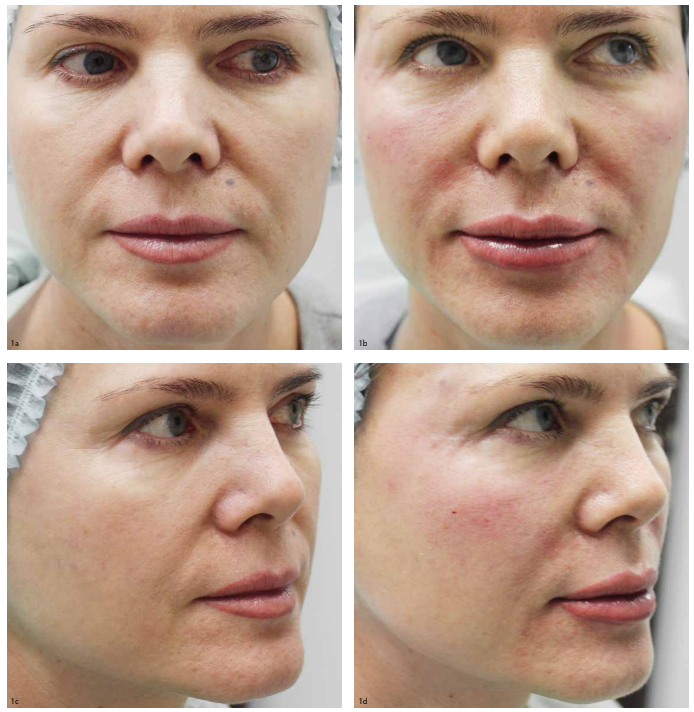
Photo 1. Patient: woman, 46 years old. A, c — before the procedures; b, d — immediately afterward
Modern contouring not only creates the desired volume while the product remains in the tissues, but also promotes the formation of new collagen structures that support the dermal matrix and skin quality at the injection sites, even after filler biodegradation—the skin-booster effect. |
Study
Selected Medical Line initiated its own studies at the Department of Dermatovenereology and Cosmetology of the Central State Medical Academy of the Administrative Directorate of the President of the Russian Federation. Clinical and instrumental studies were conducted, including photographic documentation, magnetic resonance imaging immediately after injection and at one and six months, and morphological studies before and four months after injection.
Histological findings in women before and after BiViDerma injection, as well as a comparative immunohistochemical assessment of skin changes four months after filler injection, showed increased production of elastin and type I and III collagen in the extracellular dermal matrix, indicating activation of neocollagenesis at the filler injection site. Increased neoangiogenesis was observed in the deep layers of the dermis and in the subcutaneous adipose tissue, indicating improved skin tone and trophism, which promotes better healing.
MRI at six months showed the filler in the treatment area (the filler had not migrated) and partial biodegradation of less than 50%.
Clinical case
Woman, 46 years old. Complaints of hollows under the eyes, nasolabial folds, and a tired appearance.
Objectively: tired aging morphotype, midface depression, pronounced tear trough, nasolabial folds.
Procedure protocol
Light volumization of the malar area. Focus on the projection of the zygomatic ligament; injection level: supraperiosteal; instrument: 25G×13 mm needle; product: BiViDerma V with lidocaine; volume: 1 ml per side; combined technique: two bolus injections under the zygomatic ligament on each side.
Volumization of the palpebromalar groove. Instrument: 21G×50 mm cannula; filler: BiViDerma V with lidocaine; volume: 1 ml per side. Deep supraperiosteal injection using the linear retrograde technique.
Correction of the nasolabial folds. Product: BiViDerma III with lidocaine; volume: 1 ml; combined technique: bolus injection with a needle onto the periosteum in the projection of the maxillary ligament, 0.25 ml on each side; the remaining 0.5 ml was evenly distributed with a 23G×50 mm cannula using the linear retrograde technique, deep in the projection of the maxillary ligament.
Lip shaping. Product: BiViDerma III with lidocaine; instrument: 27G×13 mm needle; Paris technique. Mid-level injection.
Correction results
A rested, refreshed appearance achieved by filling and smoothing the tear trough and nasolabial folds and naturally volumizing the lips. Focusing on the malar area harmonized the facial oval. The expected effect of the procedure is 9–12 months, after which the procedure can be repeated. With an integrated approach—improving skin quality (injectable and device-based treatments), an appropriately selected skincare routine, and lifestyle changes—more long-lasting results can be achieved with HA-based filler contouring, and individual areas can be corrected as needed.